What changes when an autoinjector has to deliver more
September 21 2026
Autoinjectors have traditionally served subcutaneous doses of around 1.0-2.0 mL, a range that most mature handheld systems already handle well. At the other end of the scale, volumes above roughly 10.0 mL are the domain of infusion formats such as pumps and on-body injectors. Between the two sits a less settled area, roughly 2.0-5.0 mL, where neither approach fits cleanly. Manual delivery begins to strain against the forces the volume demands, while infusion systems can be more than the dose requires. SHL Medical sees this low-to-medium range as where some of the most interesting development questions now sit.
Whether the range is workable comes down, in part, to tolerability. One published review found that subcutaneous injections of around 1.5 mL are generally well accepted, with some studies reporting that volumes up to 3.0 mL can be tolerated when injected into the abdomen.1 Research into the wider 2.0-5.0 mL space is increasing, though the evidence specific to handheld autoinjectors remains relatively limited.
The challenge is not simply to hold more volume. Once delivery moves beyond the conventional range, what happens during the injection depends less on capacity and more on how several factors interact.
What the clinical evidence shows
The research that does exist has tested how far the range can be pushed, and under what conditions, though much of it relies on infusion pumps rather than handheld autoinjectors.
In a randomized controlled study, subcutaneous saline administrations ranging from 1.0 mL to 5.0 mL were delivered by infusion pump to 24 healthy adults. The study tested different volumes delivered at different rates, assessing the acceptability of each based primarily on injection site pain reported by participants. Three combinations met the study’s predefined acceptability criteria, including 4.0 mL delivered in 58 seconds and 3.0 mL over two minutes. Larger volumes and faster delivery rates were associated with higher pain scores, but these remained within the study’s acceptability threshold.2
An earlier crossover study evaluated 3.5 mL of a 5 cP placebo buffer delivered by infusion pump over one, four, or ten minutes. Immediate mean pain scores were highest after the one-minute injection and lowest after the ten-minute injection. The study established injection time as a measurable variable in tolerability assessment.3
A 2024 review by the Subcutaneous Drug Development and Delivery Consortium identified a broader range of device, delivery, formulation, and patient factors that may influence pain and tolerability, including volume, delivery rate, cannula characteristics, injection site, viscosity, pH, and osmolality.4
Taken together, these findings suggest that tolerability is not determined by volume alone, but by the interaction of factors within a broader delivery profile. In an autoinjector, several of those factors are set by the device.
When larger volumes move into handheld delivery
For a given flow path and flow rate, increasing volume extends injection time, which sets how long the device must stay against the skin until the delivery is complete. Raising the flow rate shortens that time but changes the pressure required inside the device and the rate at which the fluid enters the tissue. Higher viscosity adds to the pressure within the fluid path and the drive force needed to maintain the intended rate.
Cannula gauge and length introduce further considerations around flow resistance and injection depth, shaping both device performance and how the formulation disperses once it reaches the tissue. Research here is now moving beyond pain scores, using imaging to observe how depots form during autoinjector delivery and how volume, viscosity, and injection rate shape the distribution of fluid within tissue.5,6
These relationships matter more as viscosity increases, or where a formulation brings added stability or material-compatibility considerations. Volume capacity, then, is only the starting point. The primary container, flow path, cannula, drive system, and injection time have to work together within the device architecture.
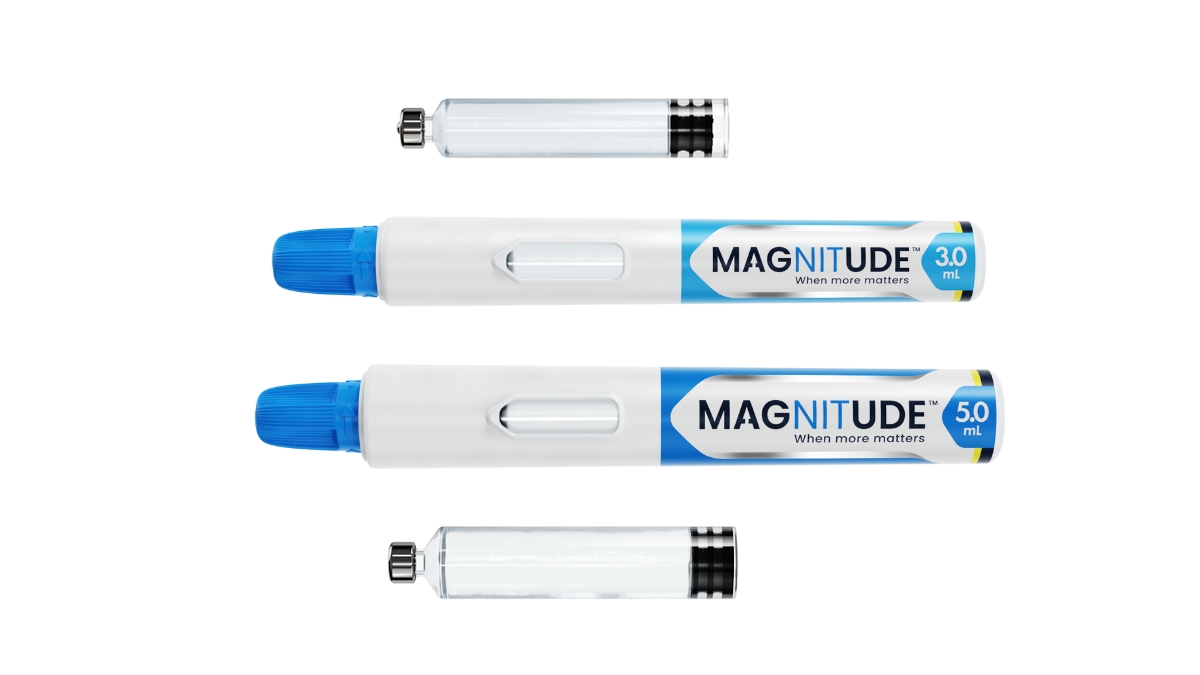
This is the challenge SHL Medical set out to address with Magnitude, the cartridge-based autoinjector previously known as Maggie.
Where Magnitude sits
Magnitude’s cartridge-based architecture separates the primary container from the injection cannula. This allows cannula gauge and length to be considered alongside the formulation and intended delivery profile.
Connecting the cartridge and the cannula reliably at the point of use has its own challenge, and SHL Medical’s proprietary Needle Isolation Technology (NIT) is designed to address it. What that enables within Magnitude will come into sharper focus in the months ahead.
Advancing the field end to end
Since introducing our cartridge-based autoinjectors for large-volume delivery, SHL Medical’s work has extended beyond the device itself, into both the science and manufacturing ends.
The 2.0-5.0 mL handheld space is still thinly evidenced, and we are helping to close that gap through preclinical research into how large volumes behave once they reach the tissue. Beyond the science, we continue to build and mature the manufacturing ecosystem behind large-volume programs with our partners, so that a device designed for this range can be produced and scaled reliably.
Magnitude will be featured at CPHI Milan, the PDA Universe of Pre-Filled Syringes and Injection Devices in Palm Springs, and PODD® in Boston this October. Meet the SHL Medical team at any of the three conferences to discuss your large-volume delivery needs.
References
1. Usach, I., Martinez, R., Festini, T., & Peris, J.-E. (2019). Subcutaneous injection of drugs: Literature review of factors influencing pain sensation at the injection site. Advances in Therapy, 36(11), 2986-2996. https://doi.org/10.1007/s12325-019-01101-6
2. Akinseye, C., Fiorini, A., Jarvis, E. L., Fry, M., Raza, A., Soleman, S., Igwe, S., & Palmer, M. (2024). Investigation into the acceptability of moderate-to-large volume subcutaneous injections in healthy volunteers: Results from a single-center randomized controlled study. Medical Devices: Evidence and Research, 17, 369-384. https://doi.org/10.2147/MDER.S479507
3. Dias, C., Abosaleem, B., Crispino, C., Gao, B., & Shaywitz, A. (2015). Tolerability of high-volume subcutaneous injections of a viscous placebo buffer: A randomized, crossover study in healthy subjects. AAPS PharmSciTech, 16(5), 1101-1107. https://doi.org/10.1208/s12249-015-0288-y
4. Mathias, N., Huille, S., Picci, M., Mahoney, R. P., Pettis, R. J., Case, B., Helk, B., Kang, D., Shah, R., Ma, J., Bhattacharya, D., Krishnamachari, Y., Doucet, D., Maksimovikj, N., Babaee, S., Garidel, P., Esfandiary, R., & Gandhi, R. (2024). Towards more tolerable subcutaneous administration: Review of contributing factors for improving combination product design. Advanced Drug Delivery Reviews, 209, 115301. https://doi.org/10.1016/j.addr.2024.115301
5. Gresham, J., Bruin, G., Picci, M., Bechtold-Peters, K., Dimke, T., Davies, E., Blazejczyk, K., Willekens, W., Fehervary, H., & Vande Velde, G. (2024). Visualization and quantification of subcutaneous injections of different volumes, viscosities, and injection rates: An ex-vivo micro-CT study. Journal of Pharmaceutical Sciences, 113 (12), 3447-3456. https://doi.org/10.1016/j.xphs.2024.08.019
6. Derakhshandeh, R., Meyers, B. A., Zhang, J., Veilleux, J.-C., Shi, G. H., & Vlachos, P. P. (2025). Subcutaneous depot formation and diffusion in autoinjector delivery: Insights from high-speed synchrotron imaging. International Journal of Pharmaceutics, 681, 125804. https://doi.org/10.1016/j.ijpharm.2025.125804